
Introducntion
International trade has transformed the way businesses operate. A company in India can purchase machinery from Germany, source electronic components from China, manufacture products in Vietnam, and sell finished goods to customers in the United States—all within the same supply chain. While globalization has created enormous opportunities, it has also introduced a critical operational requirement: customs clearance.
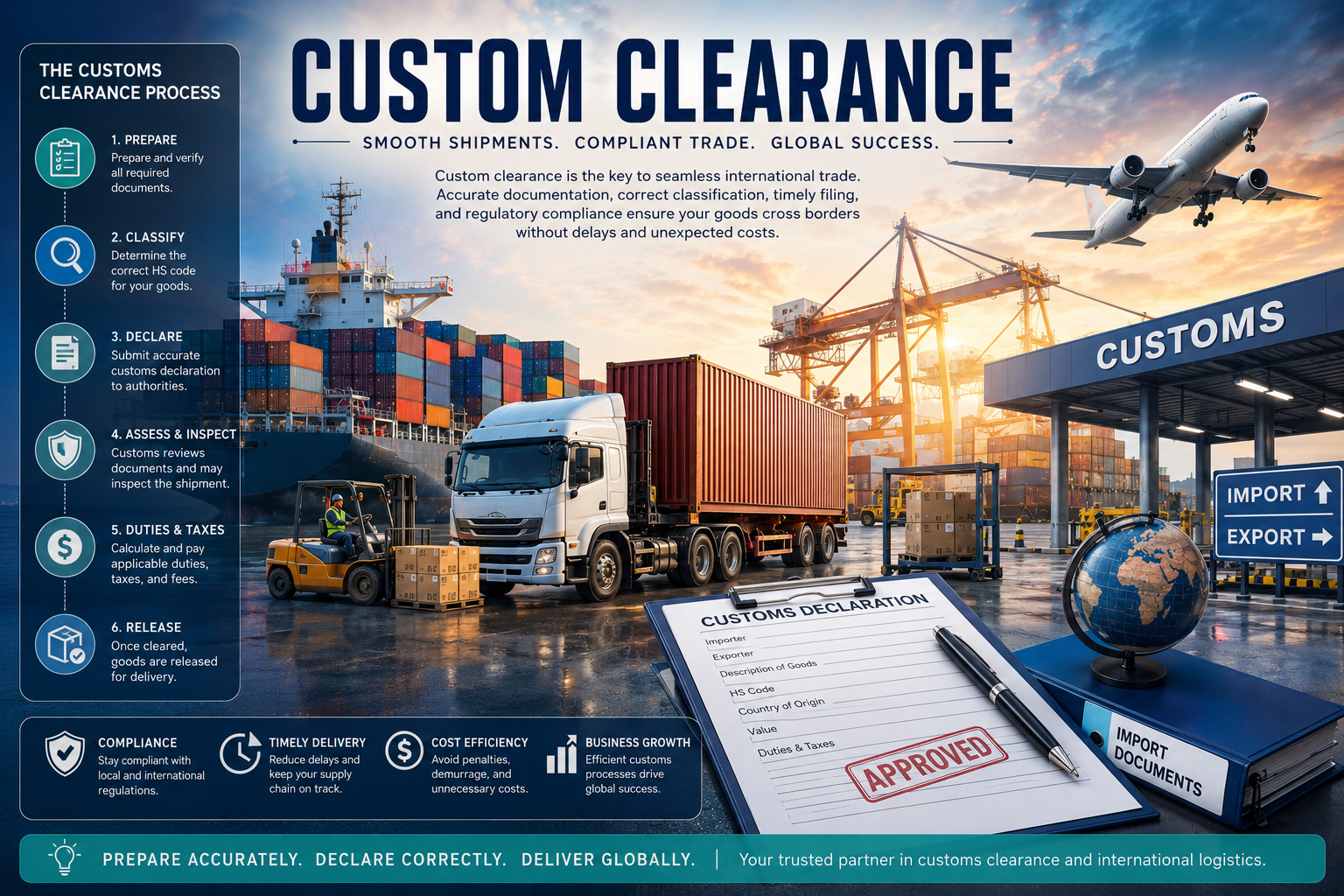
Custom clearance, more commonly written as customs clearance, is the process through which goods are officially declared to a country's customs authority before they can enter or leave that country. It involves documentation, classification, valuation, taxation, regulatory compliance, inspection, and coordination between importers, exporters, customs brokers, freight forwarders, shipping companies, ports, airports, and government authorities.
The declaration typically includes:
Importer information
Exporter information
Product classification
Customs value
Quantity
Country of origin
Shipment details
Applicable permits
Duties and taxes
Modern customs systems increasingly use electronic declarations.
Electronic customs systems improve processing speed, reduce paperwork, and enable authorities to conduct automated risk assessments.
Step 7: Customs Risk Assessment
After a declaration is submitted, customs authorities may perform automated or manual risk analysis.
Risk assessment can consider factors such as:
Importer history
Exporter history
Product category
Country of origin
Declared value
Classification
Shipment route
Previous compliance issues
Nature of the goods
Not every shipment receives the same level of scrutiny.
Some shipments may be cleared quickly, while others may be selected for document review or physical examination.